Are You Afraid of What Your Evidence Room Might Say?

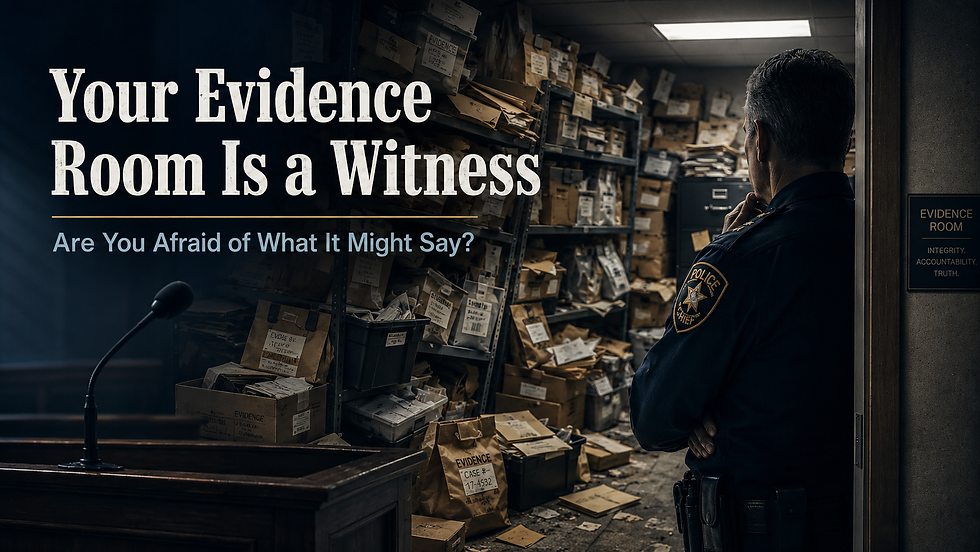
Imagine your evidence room could take the witness stand and answer one question:
“Tell us how this agency handles evidence.”
What would it say?
For some police chiefs, that question is uncomfortable because they already know—or at least suspect—the answer. They know the evidence room has been neglected, there are old cases nobody has reviewed, the computer system may not match what is physically on the shelves, and the evidence technician may have inherited years of problems from the people who came before.
Sometimes there are boxes nobody really wants to open because nobody is quite sure what they are going to find.
That creates a very understandable temptation: maybe it is better not to look too closely.
The Fear of Putting It on Paper
If you already suspect significant problems, bringing in an outside company to inventory or audit the evidence room can feel risky. What if the problems are worse than you thought? What if there are hundreds of discrepancies? What if evidence cannot immediately be located? What if the report formally documents conditions you already knew weren't good?
There can be a feeling that once those problems are written down, the agency is somehow in a worse position.
But an audit does not create the problem. It identifies the problem that already exists. And once leadership knows what actually exists, leadership can begin correcting it.
That distinction matters.
What If You Didn't Inherit the Problem?
There is another situation that deserves to be addressed honestly.
Maybe you aren't the new chief.
Maybe you have led the agency for 10, 15 or even 20 years. You have known for some time that the evidence room was not where it needed to be, but other priorities always seemed more urgent. Staffing problems came up. Budgets got tight. A new records system was installed. A major investigation consumed everyone's time. The evidence room stayed behind the locked door and another year went by.
If that describes your agency, avoiding an audit because you are concerned about what it may document is understandable—but it does not improve the situation.
At some point, every chief turns the keys over to someone else.
The next chief may order an inventory. A new evidence custodian may begin asking questions. An accreditation process, prosecutor, court case, public-records request or outside review may expose issues that have existed for years.
The difference is whether you discover and address those issues on your terms, or someone else discovers them later.
There is a much stronger leadership story in saying:
“I recognized this operation needed attention, brought in an independent review, established the true condition of the room and began correcting it.”
That is considerably different from having the next administration discover the same problems and ask why nobody acted sooner.
You cannot change what happened five or ten years ago. You can change what happens next.
Evidence Rooms Remember Everything
Evidence rooms are unlike almost any other operation inside a police department. Patrol shifts end, reports get completed, employees retire, chiefs change, computer systems are replaced and policies are rewritten.
The evidence remains.
An evidence room may contain the history of an agency going back 10, 20, 30 years or longer. That means today's evidence technician can be responsible for property submitted before they even worked for the department.
Over time, small issues accumulate. A location wasn't updated. An item was released but the RMS wasn't changed. Evidence went to a laboratory and was never reconciled. A case reached final disposition but the property was never reviewed. A new custodian took over without a complete inventory.
None of those things automatically means someone was dishonest, lazy or incompetent. Often the system simply kept moving.
Eventually, however, somebody has to stop and determine what is actually there.
A Troubled Evidence Room Does Not Automatically Mean a Bad Police Department
Some very good police departments have very difficult evidence rooms. I have met excellent evidence technicians working every day inside systems that were broken long before they arrived, and chiefs who genuinely wanted to improve operations but were staring at decades of accumulated evidence.
The condition of the room today does not have to define the agency tomorrow.
What matters is what leadership does once the problem is recognized.
There is a tremendous difference between saying, “We discovered significant legacy problems, documented them, established a baseline and developed a corrective plan,” and saying, “We knew there were problems, but we never really determined how extensive they were.”
One demonstrates leadership. The other becomes increasingly difficult to explain as the years pass.
This Should Not Be a “Gotcha” Exercise
When Police Evidence Audits enters an agency, we are not looking for someone to blame. We are looking for the truth.
What is physically here? What does the records system say should be here? What does not match? What needs immediate attention? What can be corrected? What processes need to change so the same problems don't continue accumulating?
Sometimes we find an excellent operation. Sometimes we find significant challenges. Most agencies fall somewhere in between.
The purpose is not simply to hand the chief a report listing everything that is wrong. The purpose is to give leadership an accurate picture of the operation and answer the more important question:
What do we do next?
Establishing a Line in the Sand
One of the most valuable results of an inventory or audit is establishing a point in time.
This is what existed. This is what was located. These are the discrepancies we identified. These are the legacy issues. These are the corrective actions we initiated.
From that point forward, progress can be measured.
Without a baseline, problems from 15 years ago continue blending together with problems from last week. Nobody really knows where the old system ends and the new system begins.
An independent inventory and audit creates that dividing line.
For a new chief, it establishes what was inherited.
For a longstanding chief, it establishes the point at which leadership decided the status quo was no longer acceptable.
Both are valuable.
The Problem You Suspect Exists Is Still a Problem
If you believe your evidence room has serious issues, an audit will not magically make everything easy. Sometimes the findings are uncomfortable, and sometimes there is significant work ahead.
But uncertainty is not protection.
If there are problems involving firearms, drugs, currency, biological evidence, sexual-assault evidence, homicide evidence or citizens' property, those issues exist whether anyone has counted them or not.
Knowing gives you the ability to act.
Not knowing simply allows the problem to get another year older.
I Have Sat in the Chief's Chair
I understand the hesitation because I spent years on the other side of this conversation. As a police chief, your name is attached to nearly everything happening inside the organization. You have staffing, budgets, training, complaints, policies, community expectations and a hundred other things competing for your attention.
The evidence room can quietly remain behind a locked door.
Until one day it isn't quiet anymore.
That perspective is a major reason Police Evidence Audits exists. We are not coming into a department to embarrass employees or prove that we are smarter than the people working there. We are there to help leadership understand what it has, identify what needs attention, support the people responsible for the operation and build a realistic path forward.
The strongest thing a chief can say is not:
“Our evidence room has never had problems.”
The stronger statement may be:
“We recognized we had a problem, we went looking for the truth, and then we fixed what we found.”
That is leadership.
Your evidence room already has a story.
The question is who gets to write the next chapter.


Comments